
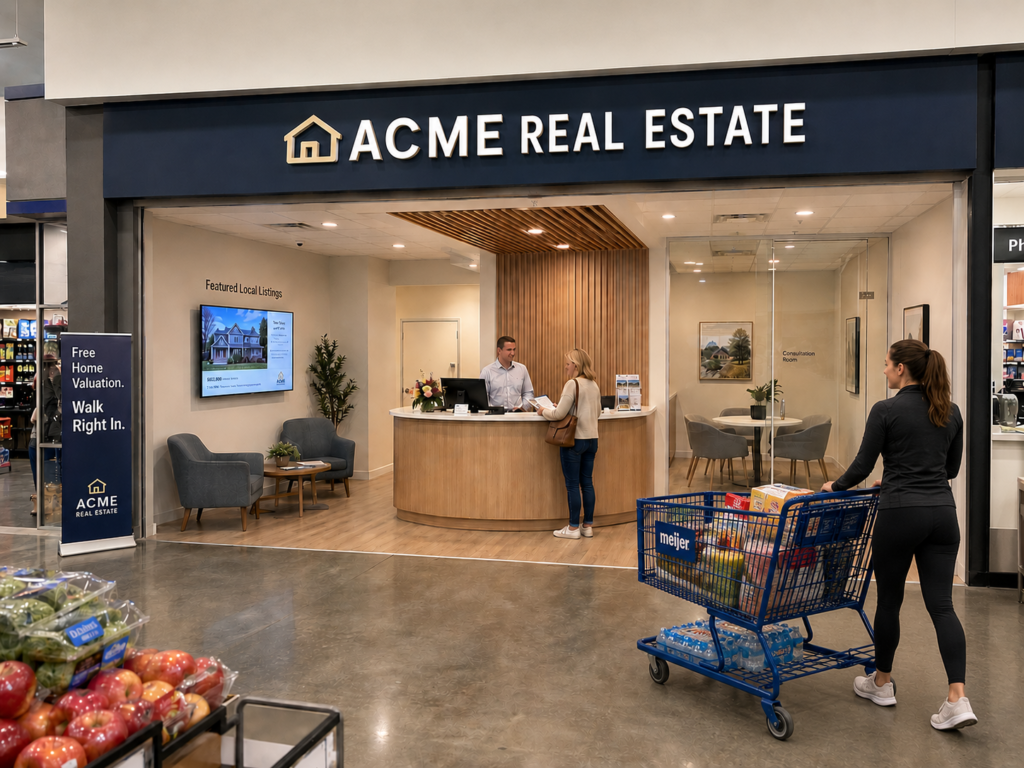
For the last decade, I’ve watched a quiet shift happen in American grocery retail. The grocers themselves don’t always talk about it openly, but if you walk the front entrance of any well-run regional or national grocery chain, you can see it clearly.
The store isn’t just a store anymore. It’s a hub. A place where households come to handle the routine work of their lives — and increasingly, some of the non-routine work too.
Customers grab a coffee on the way in. They drop a package at pack-and-ship on the way out. They get their hair cut on a Tuesday afternoon. They see their banker about a car loan. They pick up a prescription. They book a vacation at the in-store travel kiosk. They get a hearing test. Somewhere in between, they buy groceries.
This is the store-within-a-store model, and it has become one of the most strategically important pieces of the modern grocery footprint. But the way it gets discussed inside grocery real estate teams hasn’t always kept pace with how it actually behaves.
That’s the gap I want to address.
The wrong question
The most common pushback I encounter when bringing certain operator categories to grocery real estate leadership goes something like this:
“That’s an office use. That doesn’t belong in the store.”
It’s an understandable instinct. The category names sound office-coded — mortgage company, real estate brokerage, insurance agency, financial planner. The mental picture is a desk, a phone, a filing cabinet, a quiet floor of people staring at computers. And that picture genuinely doesn’t belong inside a grocery store. The customer experience would be wrong, the brand fit would be wrong, the operational impact would be wrong.
But here’s the thing: that mental picture is also wrong about the actual operators in those categories today.
The right question isn’t whether something is retail or office. The right question is whether the tenant strengthens the host store’s role as a community hub.
Two complementary patterns
When I look at the categories that already work inside grocery stores — coffee, banks, credit unions, salons, pack-and-ship, dry cleaning, wireless, optical — I see two complementary patterns, both of which strengthen the hub.
Transaction-frequent service retail. These are categories the customer engages with repeatedly. Coffee daily. Hair cut every six weeks. Package drop-off twice a month. Banking visit once a month. The storefront converts an existing grocery trip into incremental utility for the customer. Repeat visits build habit and dwell time. Hearing care, wellness, tax preparation, wireless, travel, and fitness recovery all fit this same pattern.
Community life moments. These are categories the customer doesn’t engage with every week, but when they do, the decision is significant. A home purchase. A first mortgage. A refinance. A life insurance review. A financial planning conversation. Title services. Senior services. Estate planning. These transactions are infrequent — but they are remembered. The customer remembers where the conversation happened.
Both patterns belong inside a grocery community hub. Transaction-frequent retail builds daily and weekly habit. Community life moment retail builds deep loyalty around the household’s biggest decisions. Together, they describe the full picture of what a community hub actually is.
The retail-versus-office distinction is real, and it matters
Here’s where I want to draw a sharp line, because the categories I just described are easy to confuse with categories that genuinely don’t belong inside a grocery store.
Traditional office uses — law firms, accounting back-offices, PR firms, consulting practices, staffing agencies, corporate satellite offices — are designed for privacy, secured files, scheduled appointments only, and quiet floors. They do not benefit from foot traffic. Visibility is irrelevant to their model. Walk-ins are a nuisance, not an opportunity. These operators are office tenants, full stop. They do not belong inside a grocery store and any responsible broker should turn them away before they reach the lease proposal stage.
But the modern consumer-facing operators in mortgage, real estate, insurance, financial planning, title, and senior services are categorically different. They have spent the last decade rebuilding their physical presence around storefront economics. Branded interiors. Visible consumer activity from the storefront. Walk-in tolerance. Retail hours. Mixed walk-in and appointment models. Signage as primary marketing channel. Customer-facing counters instead of back-office bullpens.
These operators are not professional services trying to look like retail.
They are retail formats that happen to deliver a professional service.
That distinction matters enormously, because once you see it, the right tenant filter becomes obvious. The filter isn’t the category name on a permitted use schedule. The filter is the operator’s actual physical presence and customer experience inside the store.
Why these operators self-select to grocery
The universe of retailers willing to operate inside another retailer’s box is small and self-selected. Traditional destination retailers want their own identity, their own frontage, their own parking, their own hours, their own customer journey. They don’t want a 400 to 1,100 square foot space inside a host store.
The operators who do choose this format choose it for specific reasons: access to existing household traffic, credibility from co-locating with a trusted community retailer, lower buildout and staffing burden than a freestanding store, a convenience-driven customer model, and a smaller footprint that supports a service-centric, lower-inventory business.
That list describes consumer-facing service retail almost perfectly. Coffee, banking, salon, pack-and-ship, hearing, mortgage, real estate, financial planning — they all share these characteristics. The format attracts them because it solves a real business problem for them.
This is why a curated SWAS program tends to skew toward these categories naturally. The category list isn’t an accident of leasing. It’s the predictable outcome of the format’s economics.
Brand transfer is the real prize
The strategic reason to think carefully about which life-moment categories belong in a grocery hub isn’t just incremental rent. It’s brand transfer.
When a customer has a positive experience with a well-run tenant inside the host store, the affinity attaches to the host. This is true for coffee. It is even more true for high-value transactions.
A customer who closes on a home through an agent they met at their grocery store remembers the grocery store as part of that life moment. A first-time buyer who sat down with a lender at the store and walked away pre-qualified attaches the grocery brand to one of the most important financial events of their adult life. A senior who navigated Medicare enrollment with a trusted advisor inside their familiar grocery store remembers that experience.
That kind of brand affinity cannot be bought through advertising. It is earned through proximity, trust, and convenience. Grocery retailers are uniquely positioned to capture it because customers are already in the store, already comfortable, and already running the rest of their lives through it.
Well-executed life-moment transactions create loyalty to the host brand by proxy. That is a brand asset, not a leasing accident.
What this means for grocery real estate teams
The implication for grocery real estate leadership is straightforward. The store-within-a-store program is not a leasing exercise. It is a curation discipline.
Every well-chosen tenant compounds the host brand’s value as a community hub. The right framework treats consumer-facing service retail as a strategic extension of what the store already does — meet households where they are, serve the routines and milestones of community life, and accumulate small moments of trust that grow into deep customer loyalty over time.
The categories already working inside grocery stores prove the model. The opportunity is to extend it intentionally, with the right operators, presented to consistent standards, in both transaction-frequent and community life moment patterns.
The right question isn’t retail versus office.
It’s whether the tenant strengthens the store’s role as a community hub.